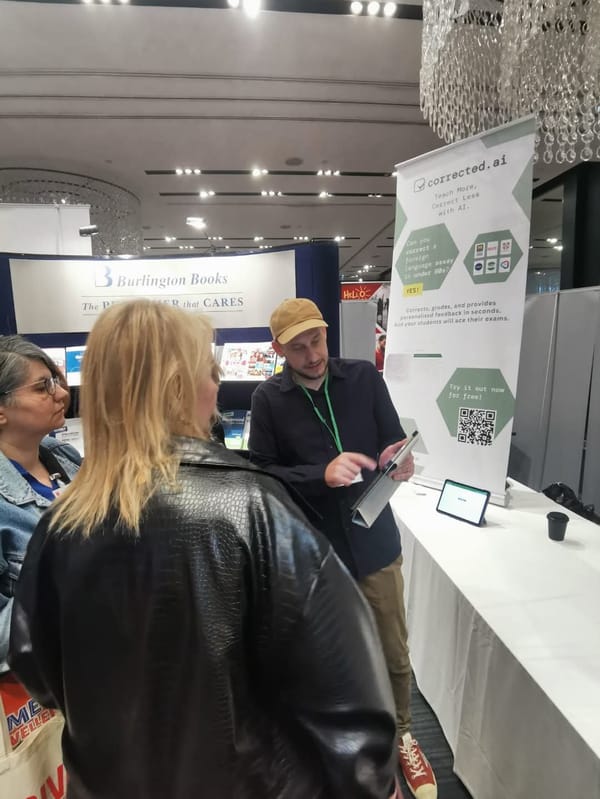
Planning the Academic Year Ahead with corrected.ai

A new school year is always a moment full of fresh energy and hopes for a better new year. And this is indeed a great opportunity for us to enter the classroom with new ideas, fresh materials, and the revived determination to help our students succeed. Yet the reality of long hours, stacks of written assessments, and the pressure of exam preparation can quickly erode that optimism, as can our established workflows and work habits. This is why rethinking workflow and building technology into our new academic plan is no longer optional—it is an essential part of teaching in the 21st century.
We all know writing is central to language learning. It develops not just grammar and vocabulary, but also critical thinking, organization, and the ability to express ideas coherently. It is also no secret that this is one of the most time-consuming tasks for teachers to evaluate. Studies have repeatedly shown that effective feedback is among the most powerful influences on student achievement (Hattie, 2009), but providing detailed and consistent comments on every assignment is one of the biggest drains on teacher time. We often spend hours every week correcting written work, time that could otherwise be invested in lesson planning, differentiation, or meaningful interaction with students.
This is where corrected.ai comes in. By incorporating it into the yearly teaching plan, we can set clear routines: handwritten or typed texts are uploaded digitally, feedback is generated instantly, and the teacher’s role shifts from mechanical correction to higher-value mentoring. Research on AI-assisted learning suggests that when students receive timely, targeted feedback, their engagement and retention improve significantly (Luckin et al., 2016; OECD, 2021). Instead of waiting days for their assignments to be returned, learners can see their strengths and weaknesses almost immediately, which allows them to revise faster, internalize lessons more effectively, and stay engaged.
From the teacher’s perspective, corrected.ai can save up to five hours a week by automating grading tasks. That time can be redirected into lesson design, personalized student support, or even professional development—areas that directly impact student outcomes. Surveys show that teachers using AI tools often feel they can spend more time connecting with students one-to-one (Education Week, 2023). This shift is particularly valuable in exam-focused contexts. Preparing learners for IELTS, Cambridge, Michigan, or TOEFL etc requires not only repeated practice but also very specific guidance. corrected.ai aligns with rubric-based assessment, ensuring that students receive structured, exam-relevant feedback consistently. For teachers planning their academic year, this means writing tasks can be scheduled more frequently without creating unmanageable marking loads. Students benefit from more practice, and teachers maintain balance in their workload.
Integrating corrected.ai also opens the door to data-informed teaching. Over the course of the term, patterns of errors and recurring weaknesses become visible. If many students are struggling with cohesion, or consistently misusing tenses for example, this data can shape the next week’s lesson plan. Research into learning analytics highlights how such data-driven instruction leads to more targeted teaching and improved learning outcomes (Siemens & Baker, 2012). Teachers no longer have to rely solely on intuition; they can plan lessons supported by evidence drawn directly from their students’ writing.
Perhaps most importantly, this integration improves student confidence. One of the major challenges in EFL classrooms is maintaining motivation, especially when progress feels slow. Receiving immediate, constructive feedback reduces frustration and builds momentum. A number of studies highlight that students who receive faster, more focused feedback on writing tasks are not only more motivated but also more likely to persist in exam preparation (Cambridge English, 2022; Nature, 2024). By planning a workflow that includes corrected.ai, teachers create an environment where success is visible and incremental, reinforcing student resilience throughout the year.
As we map out our academic calendar, let’s consider how corrected.ai can be woven into the rhythm of our teaching:
- Let’s begin by scheduling regular written assignments that are corrected through the platform
- Use the insights to adjust lesson planning, and
- Carve out more time for activities that cannot be automated—face-to-face conversations, encouragement, and creative thinking.
Teaching English will always be a human endeavor, but with the right tools, the human element can shine more brightly.
The new school year is not just a chance to return to familiar routines; it is an opportunity to reimagine them. With corrected.ai integrated into our workflow, we are not only saving time—we are giving our students a better chance to succeed, and giving ourselves the space to teach at our best.
And just to show how easy it is, here is a short video showing the steps:
References
- Hattie, J. (2009). Visible Learning: A Synthesis of Over 800 Meta-Analyses Relating to Achievement. Routledge. Publisher link
- Luckin, R., Holmes, W., Griffiths, M., & Forcier, L. B. (2016). Intelligence Unleashed: An Argument for AI in Education. Pearson. Open access PDF
- OECD (2021). Digital Education Outlook 2021: Pushing the Frontiers with AI, Blockchain and Robots. OECD Publishing. DOI link
- Education Week (2023). What Educators Think About Using AI in Schools. Article link
- Siemens, G., & Baker, R. S. (2012). Learning Analytics and Educational Data Mining: Towards Communication and Collaboration. In LAK ’12. ACM. Open PDF
- Cambridge English (2022). Research Notes: Issue 83 – Feedback in Language Assessment. Cambridge University Press & Assessment. Link